A Mission From God

Luke 9.51-62 / Galatians 5.16-26
In his 2017 book, The God Shaped Heart, author Timothy Jennings writes of the dangers of unrecognized heart issues:

Hypertension—high blood pressure—has been called the silent killer, but medical professionals didn’t always realize this. In fact, some doctors argued that hypertension was a made-up disorder that didn’t need to be treated at all. For instance, in 1931 Dr. J.H. Hay proclaimed, “The greatest danger to a man with high blood pressure lies in its discovery, because then some fool is certain to try and reduce it.”

Tragic results followed from this idea. Consider the true case of Frank. Frank was diagnosed with hypertension in 1937 at the age of fifty-four. His blood pressure was 162/98 and was considered by physicians at the time to be “mild hypertension.” No treatment was initiated. By 1940, his blood pressure was running 180/88. In 1941, his pressure was 188/105. He was encouraged to cut back on smoking and work. But his condition didn’t improve.

By 1944, his pressure was running higher, and he suffered a series of small strokes. This was followed by classic symptoms of heart failure, so he was placed on a low-salt diet with hydrotherapy and experienced some improvement.

But by February 1945, his pressure was 260/145, and on April 12, 1945, he complained of a severe headache with his blood pressure measuring at 300/190. He lost consciousness and died later that day at the age of sixty-three. Perhaps you know him better as Franklin Delano Roosevelt, the thirty-second president of the United States.

In this morning’s text, chosen for us by the lectionary, we are going to hear more about the dangers of unrecognized heart issues. However, the heart issues that Jesus tells us about, in this Biblical text, have more than immediate physical consequences.  The heart issues that Jesus points out have spiritual and eternal consequences.

Luke 9:51–62 shares this piece of history with us:

[51] When the days drew near for him to be taken up, he set his face to go to Jerusalem. [52] And he sent messengers ahead of him, who went and entered a village of the Samaritans, to make preparations for him. [53] But the people did not receive him, because his face was set toward Jerusalem. [54] And when his disciples James and John saw it, they said, “Lord, do you want us to tell fire to come down from heaven and consume them?” [55] But he turned and rebuked them. [56] And they went on to another village.

[57] As they were going along the road, someone said to him, “I will follow you wherever you go.” [58] And Jesus said to him, “Foxes have holes, and birds of the air have nests, but the Son of Man has nowhere to lay his head.” [59] To another he said, “Follow me.” But he said, “Lord, let me first go and bury my father.” [60] And Jesus said to him, “Leave the dead to bury their own dead. But as for you, go and proclaim the kingdom of God.” [61] Yet another said, “I will follow you, Lord, but let me first say farewell to those at my home.” [62] Jesus said to him, “No one who puts his hand to the plow and looks back is fit for the kingdom of God.” (ESV)

The first thing we hear in this text is that Jesus set his face toward Jerusalem.

Why does the Gospel writer Luke tell us this fact? What does this mean for Jesus and His disciples?

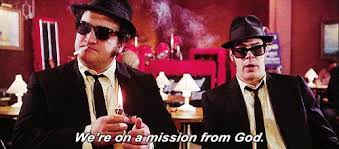
Well, borrowing the words of John Belushi and Dan Aykroyd in 1980’s, The Blues Brothers, Jesus and His disciples could answer “our faces are set on Jerusalem because,” “We’re on a mission from God!”

And, what was the mission from God that Jesus was on?

The mission from God that Jesus was on was to save you and me, and every other man, woman, and child, at every point in mankind’s history, from having the wrath of God poured out upon us condemning us for our Sin.

When asked why the baby given to Mary and Joseph should be named Jesus, the answer was, “for He will save people from their sins” (Matthew 1.21, ESV).

On His way to Jerusalem, where Jesus would would solidify the forgiveness of Sin by dying on the cross in our place, Jesus was stopping along the way to prepare the people to be reconciled to God with His simple message of, “Repent and Believe.”

However, just like today, people reject that message for many reasons.

Some think, “Who are you to tell me that I am a sinner in need of forgiveness? Don’t judge me!”

Some think, “I am a good person doing good things that will certainly earn me points in the afterlife—whatever that looks like. I don’t need to confess anything or ask for forgiveness.”

While others think, “There is no god.  Or, we can’t know if there is a god.  Stop throwing that God-talk in my face.”

Something similar happened in the village of the Samaritans that Jesus wanted to visit.  The Samaritans made it clear that they didn’t want or need Jesus.  They didn’t want or think they needed His message of Good News.  And, they didn’t think they needed what He was offering them—forgiveness of sin and reconciliation with God, their Father, their Creator and Redeemer.

So, as today’s Biblical text tells us, Jesus was never able to set foot in the Samaritan village to bring His Good News of forgiveness and eternal life because His disciples were told that Jesus wasn’t welcome in that place.

In reaction to the Samaritans rejection of Jesus, Jesus’ disciples do what we often do.  Jesus’ disciples jump to immediate and total judgment of those that deny Christ.  They ask Jesus if they can call down fire from Heaven to completely destroy these unbelievers and wipe them off the face of the earth with eternal punishment.

At this point an interesting thing happened.

The interesting and Good News for you and me is this part of the story where we see Jesus’ reaction to the the Samaritans rejection of Him and His disciples sinful quick-to-judge attitude.  

Jesus tells His disciples that He does not wish for them to punish the Samaritans for their unbelief.  In fact, Jesus rebukes His disciples for their sinful attitude of being quick-to-judge others.

This is the interesting part because it shows us nothing less than the overwhelming patience and grace of God with sinners like you and me.

It is God’s desire, as Scripture tells us, that every man, woman, and child come to the saving knowledge of Jesus Christ alive, dead, and resurrected for their eternal good.

In order for that to happen, God is patient with us along the way because He knows that Sin makes us stubborn and we will be quick to deny Christ, like the Samaritans did.  And, like His disciples, we will be quick to claim self-righteousness, and quick to Sin in ways such as judging others for their faults while we are unrepentant sinners ourselves.

God loves us.  So, God gives us more than one chance, more than 1000 chances, more chances than we will ever know, to hear about Jesus Christ and respond with faith.

After this incident with both the Samaritan villagers and the disciples following their hearts into the Sin of denying Jesus and His Commandments, which prompt us to love God and love others, we are given a few more examples of people wanting what their sinful hearts want and not the blessings that Jesus offers them.

One person wants to follow Jesus for all of the blessings that He has to offer them, but doesn’t want the suffering and rejection that come from doing what God commands instead of doing what the broken world encourages.

And, two other separate individuals want to follow Jesus only after they have take care of matters at home and feel like everything is in order as they would like it to be.

In 1862, American Poet Emily Dickinson wrote, “The heart wants what it wants, or else it does not care.”  This quote has made it’s way into popular culture in numerous ways.  Two examples from my lifetime were Woody Allen using it in an interview in the 1990s and Selena Gomez stealing it for a song in 2014.

The sad reality is that we hear Dickinson’s quote and miss the warning in it.  We don’t hear that our heart is selfish and doesn’t care about anyone or anything except what will make us happy in the immediate moment.  We only hear what we want to hear. So, we hear that our heart should be our light and our guide, leading us to true happiness.  

When my son was younger, he watched a show on the Disney Channel called Jake and the Neverland Pirates.  In one segment of one of the episodes, Jake danced around his pirate ship  encouraging children with the terrible advice to “always follow you heart.”

What we miss in all of this heart-talk is the truth of humanity.  The truth is that the heart is sinful from the moment of conception.  Our default setting is to follow the heart and what the heart wants, even though what the heart wants is to deny God and destroy others.

In 2 Peter 3:8–18, the Apostle Peter, speaks of God’s grace-led patience with us.  Peter says:

[8] But do not overlook this one fact, beloved, that with the Lord one day is as a thousand years, and a thousand years as one day. [9] The Lord is not slow to fulfill his promise as some count slowness, but is patient toward you, not wishing that any should perish, but that all should reach repentance. [10] But the day of the Lord will come like a thief, and then the heavens will pass away with a roar, and the heavenly bodies will be burned up and dissolved, and the earth and the works that are done on it will be exposed.

[11] Since all these things are thus to be dissolved, what sort of people ought you to be in lives of holiness and godliness, [12] waiting for and hastening the coming of the day of God, because of which the heavens will be set on fire and dissolved, and the heavenly bodies will melt as they burn! [13] But according to his promise we are waiting for new heavens and a new earth in which righteousness dwells.

[14] Therefore, beloved, since you are waiting for these, be diligent to be found by him without spot or blemish, and at peace. [15] And count the patience of our Lord as salvation, just as our beloved brother Paul also wrote to you according to the wisdom given him, [16] as he does in all his letters when he speaks in them of these matters. There are some things in them that are hard to understand, which the ignorant and unstable twist to their own destruction, as they do the other Scriptures. [17] You therefore, beloved, knowing this beforehand, take care that you are not carried away with the error of lawless people and lose your own stability. [18] But grow in the grace and knowledge of our Lord and Savior Jesus Christ. To him be the glory both now and to the day of eternity. Amen. (ESV)

Jesus was on a mission from God.

The mission from God that Jesus was on was to fix the ultimate problem with your heart—the problem of Sin that made you selfish, self-centered, and self-righteous, denying your need for God’s intervention to forgive you and give you the new life that leads to an enteral home in His Kingdom of Heaven.

And, as you are told, Jesus’ mission was completely successful.

Through Jesus’ sinless life, sacrificial atoning death on the cross, and victorious defeat of death in the resurrection, your Sin is forgiven, you are made righteous and sinless in God’s eyes, and you have been made victorious over death’s power to kill and condemn you.

So, today, as we have been set free by Jesus Christ to live and love with brand new hearts set on God our Father in Heaven and the things above, not the things of this earth, I ask you to hear and heed Paul’s words from Galatians 5:16–26 which say to you:

[16] But I say, walk by the Spirit, and you will not gratify the desires of the flesh. [17] For the desires of the flesh are against the Spirit, and the desires of the Spirit are against the flesh, for these are opposed to each other, to keep you from doing the things you want to do. [18] But if you are led by the Spirit, you are not under the law. [19] Now the works of the flesh are evident: sexual immorality, impurity, sensuality, [20] idolatry, sorcery, enmity, strife, jealousy, fits of anger, rivalries, dissensions, divisions, [21] envy, drunkenness, orgies, and things like these. I warn you, as I warned you before, that those who do such things will not inherit the kingdom of God. [22] But the fruit of the Spirit is love, joy, peace, patience, kindness, goodness, faithfulness, [23] gentleness, self-control; against such things there is no law. [24] And those who belong to Christ Jesus have crucified the flesh with its passions and desires.

[25] If we live by the Spirit, let us also keep in step with the Spirit. [26] Let us not become conceited, provoking one another, envying one another. (ESV)

This is the Word of God for you today.

This is the Grace of God for you today.

Amen.

Reverend Fred Scragg V.

June 29, 2025.

Do The Right Thing

Romans 6.1-11

Have you ever struggled to do the right thing?

Have you ever thought to yourself, “what is the purpose of doing the right thing if I am the only one doing it?”

Maybe you’ve thought, “The people that don’t do the right thing seem to be happier, more fulfilled, and are having more fun.”

The original owners of Northwestern Mutual Life Insurance Company had the reputation for being people of integrity. The beginning of their story reveals their commitment to do the right thing—even when it cost them:

Northwestern Mutual was founded as the Mutual Life Insurance Company of the State of Wisconsin on March 2, 1857. Originally located in Janesville, Wisconsin, the fledgling company relocated to Milwaukee in 1859. Shortly after, the company experienced its first two death claims, when an excursion train traveling from Janesville to Fond du Lac, Wisconsin, derailed, killing 14 people, two of whom were policy owners. With losses amounting to $3,500 and having funds of only $2,000, company President Samuel Daggett and Treasurer Charles Nash personally borrowed the needed funds to pay the claims immediately.

Later when asked why they didn’t simply default on the payments, they replied it would not have been the right thing to do to their fellow man. They both agreed they would rather see the company fail than neglect their obligation to those who trusted them to keep their word.

Doing the right thing can be hard.

Always choosing right over wrong can feel like a daunting task, especially in the moments of decision making.

In this morning’s Biblical text, chosen for us by the lectionary, we are going to hear the apostle Paul give us the encouragement we need to walk every day in the right and the light of our faith as defined in God’s commandments for life and love.

Let’s hear from the apostle Paul’s letter to the Christians gathered in the city of Rome during the first century now.

Romans 6:1–11 says this:

[1] What shall we say then? Are we to continue in sin that grace may abound? [2] By no means! How can we who died to sin still live in it? [3] Do you not know that all of us who have been baptized into Christ Jesus were baptized into his death? [4] We were buried therefore with him by baptism into death, in order that, just as Christ was raised from the dead by the glory of the Father, we too might walk in newness of life.

[5] For if we have been united with him in a death like his, we shall certainly be united with him in a resurrection like his. [6] We know that our old self was crucified with him in order that the body of sin might be brought to nothing, so that we would no longer be enslaved to sin. [7] For one who has died has been set free from sin. [8] Now if we have died with Christ, we believe that we will also live with him. [9] We know that Christ, being raised from the dead, will never die again; death no longer has dominion over him. [10] For the death he died he died to sin, once for all, but the life he lives he lives to God. [11] So you also must consider yourselves dead to sin and alive to God in Christ Jesus. (ESV)

Have you ever thought to yourself,

“If Jesus has already forgiven me of my Sin—my sins from the past, my sins in the present, and even the sins that I will commit in the future—why can’t I just do whatever I want right now?  After all, I am forgiven by God and will be forgiven by God anyway?”

If you have thought that at one point or another, and I know you probably have, because I have, I want you to know that you aren’t alone.

That’s how tricky sin and Satan are.  They corrupt our thinking to the point where we think we can get one over on God.

It is this exact broken train of thought that the apostle Paul had to confront in the church around 2000 years ago as witnessed by our Biblical text this morning.

Our text begins with Paul presenting the question, “What shall we say then? Are we to continue in sin that grace may abound?”

Here, in his letter to the Christians gathered in the city of Rome during the 1st Century, Paul is not posing this question as one to be answered by the hearers. 

No! Paul is posing the question that he has heard from the Christians gathered in the city of Rome so that he can correct their thinking that is broken and corrupted by the Sin that dwells within us and seems so close whenever we want to do the right thing.

Paul sums up the way he feels, which is very often the way we feel a bit later in this same letter, that often leads to the train of thought being confronted at the outset of this Biblical text.

Romans 7:14–8.1 says this:

[14] For we know that the law is spiritual, but I am of the flesh, sold under sin. [15] For I do not understand my own actions. For I do not do what I want, but I do the very thing I hate. [16] Now if I do what I do not want, I agree with the law, that it is good. [17] So now it is no longer I who do it, but sin that dwells within me. [18] For I know that nothing good dwells in me, that is, in my flesh. For I have the desire to do what is right, but not the ability to carry it out. [19] For I do not do the good I want, but the evil I do not want is what I keep on doing. [20] Now if I do what I do not want, it is no longer I who do it, but sin that dwells within me.

[21] So I find it to be a law that when I want to do right, evil lies close at hand. [22] For I delight in the law of God, in my inner being, [23] but I see in my members another law waging war against the law of my mind and making me captive to the law of sin that dwells in my members. [24] Wretched man that I am! Who will deliver me from this body of death? [25] Thanks be to God through Jesus Christ our Lord! So then, I myself serve the law of God with my mind, but with my flesh I serve the law of sin. (ESV)

[1] There is therefore now no condemnation for those who are in Christ Jesus. (ESV)

When theologians get together to discuss some of the finer points of theology, one of the things they discuss is the way God uses his Law in our lives.

I teach the 3 Uses of the Law to all of my confirmation classes by having them memorize the following paragraph:

The Law is that part of God’s Word which tells us what we must do and what we must not do.  It has two, possibly three uses: 1) to curb our natural tendencies by telling us what we must do under penalty of punishment or failure; 2) to convict of sin by describing where we have failed to keep the law, thus showing us our need for a Savior; and 3) to coach the believer regarding what Christ has given the believer to do.

Today’s text has Paul teaching what we would call “The 3rd Use of the Law.”

In the 3rd Use of the Law, we are told that God’s Law has an important place in the life of the believer.

This is very important to understand because there are many traditions that would call themselves “Christian,” but in fact deny that God’s Law has a place in the life of a person once they come to faith in Jesus Christ.

The wrong thinking of such heretical groups goes like this: “Jesus has done all that needs to be done for me.  I am forgiven yesterday, today, and tomorrow.  So, there is no need for me to follow any rules or standards for life and love found in the Bible.”

Those that believe that God’s Law has no place in the life of a person once they come to faith have been historically known as antinomians.

Antinomian comes from the combination of two ancient words; anti, meaning, “against,” and, nomos, meaning, “law.”

So, when you put them together, you are referring to those who are against God’s Law.

Why am I telling you all of this stuff?

I am telling you all of this stuff because it directly relates to what Paul was speaking about in this morning’s Biblical text.

Here’s the order of thought that the apostle Paul is confronting:

God’s Law shows me and the world what sin is.

When I sin, God has the chance to forgive me and show the world that he is a forgiving God.

Therefore, I should just keep sinning, or living like God’ Law doesn’t exist—living in complete disobedience to God’s standards for life and love—so that He can continue to show His love through forgiveness to me and the world.

As much as we would also confront that wrong way of thinking and behaving, we tend to think and behave in this exact way when the rubber meets the road of life.

We think differently than God who created us, forgives us, and rescues us.

And, we act differently than God who created us, forgives us, and rescues us.

[24] Wretched man that I am! Who will deliver me from this body of death? [25] Thanks be to God through Jesus Christ our Lord! So then, I myself serve the law of God with my mind, but with my flesh I serve the law of sin. (ESV)

[1] There is therefore now no condemnation for those who are in Christ Jesus. (ESV)

Jesus Christ, Himself tells us that God’s Law is important for our lives and that He didn’t come to get rid of it.

In the disciple Matthew’s biography of Jesus, Jesus says to those listening to the particular sermon that he is giving:

[17] “Do not think that I have come to abolish the Law or the Prophets; I have not come to abolish them but to fulfill them. [18] For truly, I say to you, until heaven and earth pass away, not an iota, not a dot, will pass from the Law until all is accomplished. [19] Therefore whoever relaxes one of the least of these commandments and teaches others to do the same will be called least in the kingdom of heaven, but whoever does them and teaches them will be called great in the kingdom of heaven. [20] For I tell you, unless your righteousness exceeds that of the scribes and Pharisees, you will never enter the kingdom of heaven. (Matthew 5.17-20, ESV)

And, Jesus’ brother, James, reminds us of the connection of faith and works, the connection that faith such inform works, or that our creeds should inform our deeds, when he says:

[14] What good is it, my brothers, if someone says he has faith but does not have works? Can that faith save him? [15] If a brother or sister is poorly clothed and lacking in daily food, [16] and one of you says to them, “Go in peace, be warmed and filled,” without giving them the things needed for the body, what good is that? [17] So also faith by itself, if it does not have works, is dead.

[18] But someone will say, “You have faith and I have works.” Show me your faith apart from your works, and I will show you my faith by my works. [19] You believe that God is one; you do well. Even the demons believe—and shudder! [20] Do you want to be shown, you foolish person, that faith apart from works is useless? [21] Was not Abraham our father justified by works when he offered up his son Isaac on the altar? [22] You see that faith was active along with his works, and faith was completed by his works; [23] and the Scripture was fulfilled that says, “Abraham believed God, and it was counted to him as righteousness”—and he was called a friend of God. [24] You see that a person is justified by works and not by faith alone. [25] And in the same way was not also Rahab the prostitute justified by works when she received the messengers and sent them out by another way? [26] For as the body apart from the spirit is dead, so also faith apart from works is dead. (James 2:14–26, ESV)

The fact that Christians are known by their love and that true believers can’t help but be pushed and pulled in the direction of doing the right thing by the Holy Spirit alive and active inside of them.

We won’t always choose the right over the wrong or the light over the dark because we continue to struggle with the brokenness and corruption inside of us, but we will know the difference and have at least a desire to move toward the right and the light.

In my study this week, I was reading some of the writing of the fourth century pastor and teacher, Cyril, who served as the bishop of Jerusalem.  He also spoke to the issue of faith informing the thoughts, words, and actions of our everyday life, or to state it again, our creeds informing our deeds.  

Cyril said this:

“In this Holy [Christian] Church receiving instruction and behaving ourselves virtuously, we shall attain the kingdom of Heaven and inherit Eternal Life;”

Cyril—300 years after Jesus, Paul, and James—makes the connection between and doctrine and practice (or, the things we say we believe and the things we do).  He emphasizes, as do Jesus, Paul, and James, before him, that our actions should flow from our beliefs. 

In an earlier lecture of his, Cyril said:

“For the method of godliness consists of these two things, pious doctrines, and virtuous practice: and neither are the doctrines acceptable to God apart from good works, nor does God accept the works which are not perfected without pious doctrines.”

He goes on to explain that is it of no value to live a virtuous life and yet not believe in God; neither is it possible to retain your faith while living an unrepentant life of sin.  

When we come to faith in Jesus Christ as our Savior—the one who saves us from our Sin that separates us from God eternally—we are untied to Jesus through baptism and are made into a new creation filled with God’s presence every second of every day through the gift of the Holy Spirit.  

It is in this place that we are given the mind of Christ to see the world as Jesus sees it—as a place that ultimately needs to be loved and forgiven to find rest, peace, and hope.  It is in this state of being that we can finally love God and love others as God commands us to do.

In 1 John 2:1–6, the disciple John writes this in his first letter to the Church:

[1] My little children, I am writing these things to you so that you may not sin. But if anyone does sin, we have an advocate with the Father, Jesus Christ the righteous. [2] He is the propitiation for our sins, and not for ours only but also for the sins of the whole world. [3] And by this we know that we have come to know him, if we keep his commandments. [4] Whoever says “I know him” but does not keep his commandments is a liar, and the truth is not in him, [5] but whoever keeps his word, in him truly the love of God is perfected. By this we may know that we are in him: [6] whoever says he abides in him ought to walk in the same way in which he walked. (ESV)

Back in 1968, a theology student published in his school’s journal what he called, “The Paradoxical Commandments.”

They went like this:

  1. People are unreasonable, illogical, and self-centered. Love them anyway.
  1. If you are kind, people may accuse you of selfish ulterior motives. Be kind anyway.
  1. If you are successful, you will win some false friends and true enemies. Succeed anyway.
  1. The good you do today will be forgotten tomorrow. Be good anyway.
  1. Honesty and frankness will make you vulnerable. Be honest and frank anyway.
  1. What you spend years building may be destroyed overnight. Build anyway.
  1. People need help but may attack you if you try to help them. Help them anyway.
  1. In the final analysis, it is between you and God. It was never between you and them anyway.

This morning, rejoice, celebrate, scream, shout, and dance.  Through Jesus you are dead to sin and alive to God! 

Jesus did the right thing for you.  And, doing the right thing was hard.  He followed God’s command to give his life over to death on the cross to be the payment for your sin.  This is love.

Do the right thing this week—Walk in the newness of life that you have been given—in a manner worthy of Christ following God’s rules for life and love that He graciously gives you for your good and the good of the world around you.  This is love.

This is the Word of God for you today.

This is the Grace of God for you today.

Amen.

Pastor Fred Scragg V

January 7, 2024